Skip to content

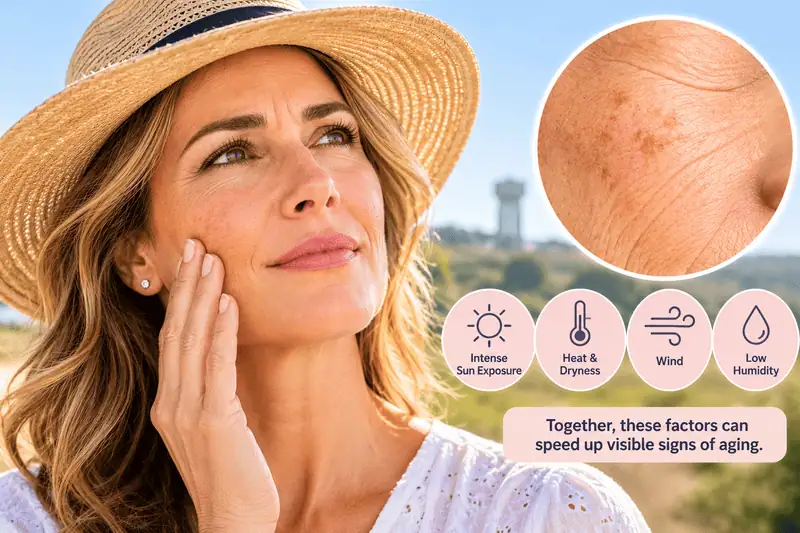
Table of Contents
Most people blame new freckles and darker patches on birthdays. In San Angelo, the weather deserves a good share of the credit. The Concho Valley sits alongside the Edwards Plateau near the edge of the Chihuahuan Desert, and that geography produces a particular mix of strong light, thin air, dry afternoons, and steady wind.
Each one affects skin differently, and together they help explain why so many residents notice uneven tone and texture earlier than expected. Here is how the local climate works on your skin and what you can realistically do about it.
How does a sun spots treatment lighten dark marks caused by sun exposure?
A sun spots treatment uses laser energy aimed at the concentrated melanin that forms after years of ultraviolet exposure, breaking that pigment into fine particles the body gradually clears through its natural processes. Because the light targets darker pigment, the surrounding skin is left largely undisturbed, and treated spots often darken briefly before flaking away and revealing a more even tone.
Five Ways the Local Climate Shows Up on Your Skin
- Abundant sunshine. San Angelo averages around 251 sunny days a year. Ultraviolet exposure is cumulative, so brief, unplanned moments like pumping gas, loading groceries, or watching a Friday night game add up over a decade.
- Higher elevation. At about 1,900 feet, the city sits well above Houston or San Antonio. Less atmosphere overhead lets slightly more ultraviolet radiation reach the ground, and summer UV index readings here commonly hit 10 or above.
- Dry afternoons. Humidity that starts fairly high at dawn often drops sharply by midday, sometimes into the teens and twenties in summer. Skin loses water to dry air faster than it can replace it, leaving the surface dull, tight, and more likely to show fine lines.
- Persistent wind. Average wind speeds run above 10 miles per hour, and spring brings gusty, dusty days. Moving air speeds up moisture loss, while airborne grit creates mild friction on exposed areas like the cheeks and forehead.
- Long stretches of heat. The area typically logs more than 100 days a year at or above 90 degrees. Heat is a known trigger for melasma, and studies suggest elevated skin temperature can activate enzymes that break down collagen.
How Sun Spots Develop
Of these factors, ultraviolet light leaves the most lasting record. When UV rays reach the skin, pigment-producing cells called melanocytes respond by making extra melanin as a defense. With repeated exposure, some of those cells stay overactive and deposit pigment unevenly. This action forms flat tan or brown marks as sun spots, age spots, or solar lentigines.
These spots rarely appear right after a sunburn. They tend to surface years later, which is why they often catch people off guard. UVA rays pass through window glass and remain fairly constant from season to season, so frequent drivers commonly see spots on the left side of the face and the back of the left hand. The chest and the tops of the shoulders are other frequent locations, since they collect sun with little thought given to coverage.
It also helps to know what you’re looking at. Freckles tend to lighten in winter, while sun spots stay put year-round. Melasma looks different again, showing up as larger, blotchy patches that often mirror each other on both cheeks and respond to hormones as well as sunlight. Telling them apart matters, because each type of discoloration can react differently to treatment.
Sun spots are usually harmless. Still, any spot that changes shape, bleeds, itches, or looks different from the others should be checked by a dermatologist.
What Daily Protection Can and Can’t Do
Broad-spectrum sunscreen with SPF 30 or higher, reapplied every two hours outdoors, limits new pigment from forming. Zinc oxide formulas are often easier on heat-sensitive skin. A wide-brimmed hat helps during long afternoons at San Angelo Park or along the Concho River, and a humidifier at home can offset the dry indoor air of winter. Topical products with vitamin C or niacinamide may lighten mild discoloration gradually.
These habits are worth keeping, but they mostly prevent new damage. Pigment that has settled in over years usually calls for a professional hyperpigmentation treatment to fade in a meaningful way.
How Long Do Sun Spots Treatment Results Last?
Results from sun spots treatment often last for several months or longer, though the timeline varies with each person’s skin and how much sun it continues to receive. Once excess pigment has been cleared, treated areas generally stay lighter as long as new melanin production is not triggered, which is why consistent sun protection afterward has such a large effect on longevity.
Some patients schedule periodic maintenance sessions to address new spots as they appear, particularly after summer, when San Angelo’s high UV levels are most likely to cause fresh discoloration.
Sun Spots Treatment in San Angelo, TX at Beauty Abound Aesthetics
Sun spots are one of the most visible signs of the sun exposure that comes with living in West Texas. At Beauty Abound Aesthetics, our Sun Spots Treatment is designed to lighten these flat, dark marks so your skin looks more even. We use laser technology to target the excess melanin in each spot, breaking it into smaller particles that your body clears naturally over the following weeks.
We can treat the face as well as the hands, chest, and shoulders. The procedure is non-invasive, and most patients return to their usual routine soon after, with some temporary redness or darkening of the spots before they fade. Because skin tone and sun history differ from person to person, we start with a consultation to determine if laser brown spot removal suits your skin and how many sessions are likely.
Our team will also ask you to avoid tanning and prolonged sun before your appointment, since recently tanned skin can make results less predictable. Many patients see a visible change within a few sessions, and improvement becomes clearer as each treated area heals.
If you’re comparing options for brown spots treatment or looking for a Sun Spots Treatment in San Angelo, TX, we’re happy to evaluate your skin and walk you through what to expect.
Book Your Skin Treatment Today.
Frequently Asked Questions
What causes sun spots?
Sun spots form when repeated UV exposure prompts pigment cells to produce excess melanin in concentrated areas of the skin.
Are sun spots dangerous?
Sun spots are typically harmless, though any spot that changes in size, color, or shape should be evaluated by a dermatologist.
How many sessions of sun spots treatment will I need?
Many patients see noticeable lightening within a few sessions, with the exact number depending on the size, depth, and number of spots.